|
Burley
was originally part of the Parish of Ringwood and it was only
separated from it in 1838 when Sir John Lefevre, Lord of the Manor
of Burley, gave part of his estate, called Barn Close, for the
erection of the first Anglican Church in the village.
The
Church of St John the Baptist, Burley was consecrated by Charles
Sumner, Bishop of Winchester, on 14th March 1839. It was a simple
rectangular building, designed by Charles Underwood, comprising
of what is now the nave and choir of the present church. The cost
of about £1,000 was raised by local subscription together
with a further sum of £1,000 for the building of a Vicarage
nearby.
Shortly
afterwards a "Dame's School" was built in the churchyard
which provided education for local children until the County School
was built some fifteen years later.
VICTORIAN TIMES
In 1851 the pews were enclosed and a gallery, reached by an outside
staircase, added at the west end. In 1886 the church was stated
to be very damp and the seats so ill-arranged that kneeling was
impossible for adults. In those days the parish clerk was paid
£3 and the organist was paid £5 per year!
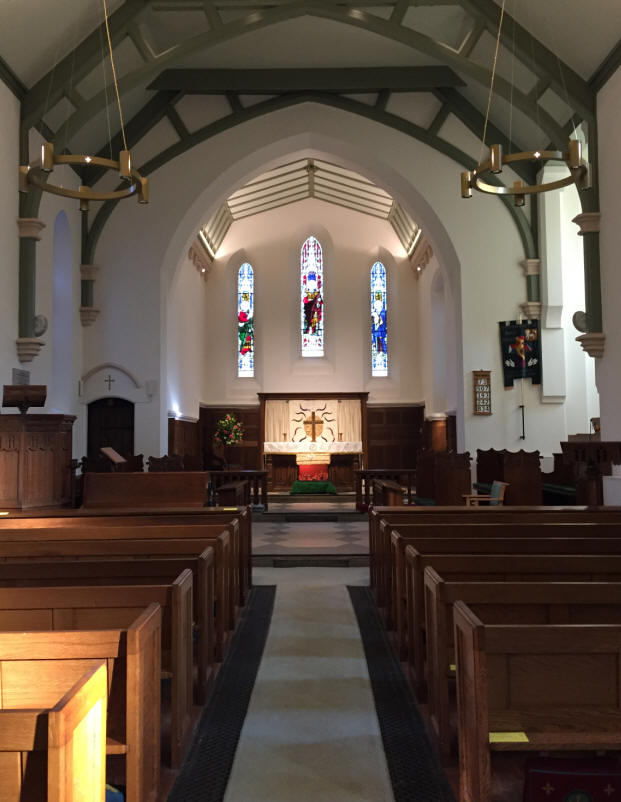
A well-known Victorian architect, William Butterfield, designed
a new sanctuary, vestry, north porch and organ chamber and these
were added in 1886/7. The gallery was removed from the west end
and better seating provided.
The 19th century Font is of grey and white marble in which small
fossils can be found. It is covered with a carved oak lid.
THE
LAST HUNDRED YEARS
Between 1936 and 1978 the pews, choir stalls, altar rail, pulpit
and lectern, were all replaced with the fine oak ones you see
now. Many were given in memory of Burley people, including the
interesting communion table by the bookcase made by Thompson's
with the famous carved mouse.
In 1955 a Compton organ of three extended ranks replaced the Victorian
one, made by Bevington. It is still in use in the Parish Church
of Hook in Hampshire. The present organ a Copeman Hart digital
electronic one, was installed together with the new sound system
in 1998. |
|
The
White Ensign over the west door was presented to the parish by
the officers and ship's company of HMS Burley in 1958.
In
1967 the Victorian tiled floors in the chancel and sanctuary were
replaced with Purbeck marble and Portland stone.
The
church room, on the north side of the church, was added in 1974
and enlarged in 1987 to provide meeting rooms, kitchen facilities
and storage space. A toilet for the disabled was installed in
2004. In 2019 a complete refurbishment was
undertaken and a Church office was added.
THE
MEMORIALS
Like the windows, the memorial tablets, both in the church and
churchyard, tell their own stories of Burley people.
One,
in the churchyard not far from the north door, commemorates a
Frenchman who sought refuge in England after the Revolution of
1789 and settled in Burley as a nursery-gardener. The inscription
reads "In memory of Virtue Fey who departed this life Oct.9.1863
aged 62. Also of William Fey who died July.13.1859 aged 85. By
much largeness of heart and enterprise he gave employment to many
and his resources provided School Instruction for Burley when
it was at that time remote and destitute of any."
A
memorial on the north side of the nave bears the delightful legend
"Emma Harding. 1873-1976 a faithful member of the congregation
who continued to walk to church when past her hundredth year."
Another centenarian is commemorated on the next tablet but one.
The quality of wording of the memorial tablets repays careful
reading. They reflect well the styles of brass and stone tablets
over a period of about 100 years.
Hidden
amongst the memorial pews and furniture in the nave are two wooden
mice, the signature of Thompson who made them. To find them, look
carefully at the legs of the small table near the font and at
one of the pew seats towards the pulpit.
|
THE
WINDOWS
The stained-glass spans over 100 years, the earliest
windows dating from the Victorian restoration of 1886.
A new window was installed to celebrate the Millennium
in 2000 and another one in 2006 celebrating the life
of Sdn Ldr Vernon Churchill Simmonds and all those
pilots who took part in the Battle of Britain. Like
the memorial tablets on the walls they were nearly
all given in memory of Burley people and each has
its story to tell.
The
east window depicting St John the Baptist in the centre
together with St Luke and St Paul was given by William
Esdaile, formerly of Burley Manor. His own memorial
is the west window showing Faith, Hope and Charity,
given by his many friends. The south sanctuary window
commemorates the death of a young girl, Ruth, aged
14, and tells the story of our Lord raising a dead
girl to life.
In
the nave on the south side, St George commemorates
a soldier killed inaction in Tunisia in 1943. Near
the door is a very different window associated with
World War 1. This was given by the children of the
Sunday School in thanksgiving for peace, symbolised
by the doves.
Towards
the pulpit, the figure of Jesus knocking on the door
is reminiscent of Holman Hunt's famous painting "Behold,
I stand at the door and knock". |
|
|
|
The
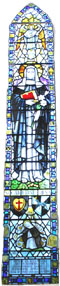
next two have North American connections. Miss Applebee,
who lived to 107, introduced woman's' hockey into America.
St Catherine of Sienna is the patron saint of Sport. Note
the hockey sticks in the border also the rebus of her name
shown as pictures of apples and bees. The Appleby
window was given in 1984 by her many American friends.
The other window in memory of Mary Warren-Taylor of New
York was given in 1936 by her great friend Miss Applebee,
who also gave the pulpit and choir stalls in her memory.
The
Millennium window on the south wall facing the
door was installed following a fund raising effort by the
whole village. The concept and original design was by a
member of the congregation, to celebrate 2000 years of Christianity. |
|
It symbolises the journey of Christianity through the ages
as it travelled around the world though the ages encompassing
people of all races.
The text on the book is from Galatians 4:4
The
latest Memorial window was installed in
2006, celebrating the life of Sqdn Ldr Vernon Churchill
Simmonds of Manor Farm, Burley, one of the Battle of Britain
pilots. many of whom gave their lives for our freedom in
World War ll. The symbolism in this window represents the
spitfires that took part in the battle, the coming home
to Manor Farm, surrounded by the Forest and the ponies.
The doves of peace overlooked by the Guardian Angel, are
a prayer in themselves. Peace on Earth. |
|
| |
 |
St
Mary Magdalene Chapel
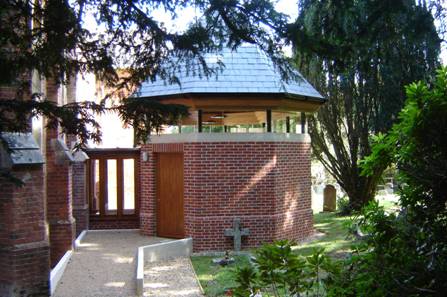
The
new St. Mary Magdalene Chapel was built in 2009 and
consecrated by the Bishop of Winchester on 4th October
in that year.
Mary was healed by Jesus and remained close to him
throughout his Ministry. The hope is that everyone
who uses the chapel will feel that same level of closeness
with Jesus as Mary did. We hope you will enjoy the
peaceful & serene surroundings that the Church
& Chapel offer.
|
|
| |
|
A BRIEF HISTORY OF BURLEY.
The name Burley comes from two Saxon words BURGH – LEAH
meaning a fortified place with fields; this refers to Castle
Hill, a Bronze or Iron Age hillfort just North of the present
village centre.
Two ancient trackways from the North and from the West,
converge here before continuing South-East to the coast near
Pennington, where limestone ledges connected the Isle of Wight
to the mainland until about 100 BCE. The hillfort
stands about 100 metres above sea level, with wide views West
and North, controlling these important routes.
The
village continued to flourish through Roman and Saxon times,
until King William ordered the clearance of the area to create
his New Forest in the year 1079 CE. To compensate the
residents of the area, they were granted "Rights of Forest”.
Any property existing before 1837 CE still holds its Rights,
and the Verderers Court in Lyndhurst still maintains the
Register showing which Rights each old property has. The free
roaming ponies, cattle and donkeys are still exercising their
Rights to wander freely, including the middle of the roads !
Burley continued as a traditional Forest farming community,
supplementing its income with an active role in the Smuggling
industry over many years, and supplementing its diet by
poaching the Royal deer.
The railway across the New Forest was opened in 1847, known as
Castleman’s Corkscrew because of the winding route chosen by
its promoter, Mr Castleman. This brought many visitors to the
New Forest, which became a favourite vacation and retirement
area from Victorian times.
Nowadays the village centre holds many shops and cafes to
attract visitors, though the old thatched roofs and cob walled
cottages still stand behind some of the newer shop fronts, and
can be seen all over the area. Walkers, cyclists and other
visitors will find Burley a worthwhile destination, and we
hope you will visit our beautiful Church. You are
very welcome to come along to one of our Church Services.
|
We
are grateful for all the help of local people in writing
this short history, especially to the late Felicity Hardcastle
BEM, our local historian, who wrote "Records of Burley"
for our enjoyment |
|